 English
 中文简体
 Français
 русский
 Español
 عربى
Content
- 1 What a Washing Machine Capacitor Actually Does
- 2 CBB60 versus CBB65: Which Case Fits the Machine
- 3 Reading the Nameplate: Capacitance, Voltage, Tolerance and Temperature
- 4 Why Washing Machine Capacitors Fail in Wet, Hot Environments
- 5 Testing and Deciding Between Replacement and Rework
- 6 Sourcing Checklist for Appliance and Motor Manufacturers
- 7 Frequently Asked Questions
A washer that fills, drains and then stands humming with a drum that will not turn usually has one failed part, and it is rarely the motor. The run capacitor supplies the phase shift a single-phase laundry motor needs in order to produce torque, and once its capacitance has fallen far enough the drum will not start, however healthy the windings are.
This guide is written for the people who specify, buy and repair these parts: appliance manufacturers, motor suppliers and technicians who need to match a replacement to a machine instead of guessing at it.
What a Washing Machine Capacitor Actually Does
A washing machine capacitor is a continuous-duty AC film capacitor wired in series with the auxiliary winding of a single-phase induction motor, where it shifts the current in that winding so the motor produces torque from a standstill.
A single-phase supply produces a pulsating field rather than a rotating one. Passing the auxiliary winding current through a capacitor delays it by roughly 90 electrical degrees, which turns that pulsating field into something the rotor can follow. The value is not arbitrary: too little capacitance and the phase shift is too small to start a loaded drum, too much and the auxiliary winding current climbs, heating the motor through every wash.
Unlike the start capacitor in a compressor circuit, which a relay switches out after a second or two, the laundry capacitor stays connected for the whole wash and spin cycle. It holds rated AC voltage for an hour at a time in a compartment warmed by the motor and damp from the drum, which is why the part is specified as a run capacitor with a defined life class. The practical differences between run and start duty in CBB motor capacitors come down to that continuous stress.
Failure mode matters as much as capacitance. A device that loses capacitance refuses to start, which is inconvenient but safe; a device that breaks down internally pushes the full winding current through the auxiliary coil and can destroy the motor in seconds. Safety-class parts exist for exactly that reason.
CBB60 versus CBB65: Which Case Fits the Machine
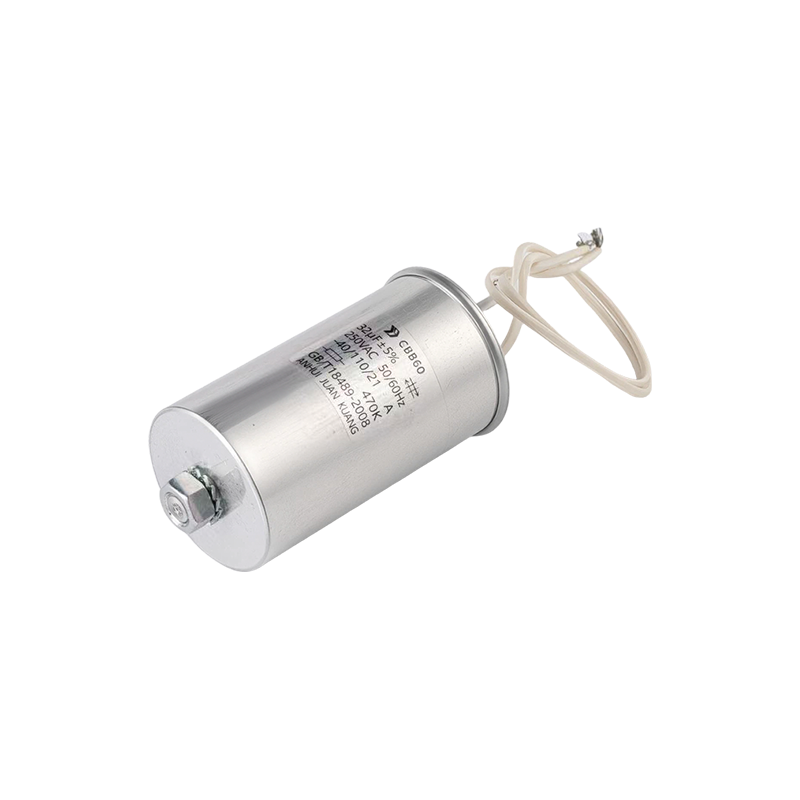
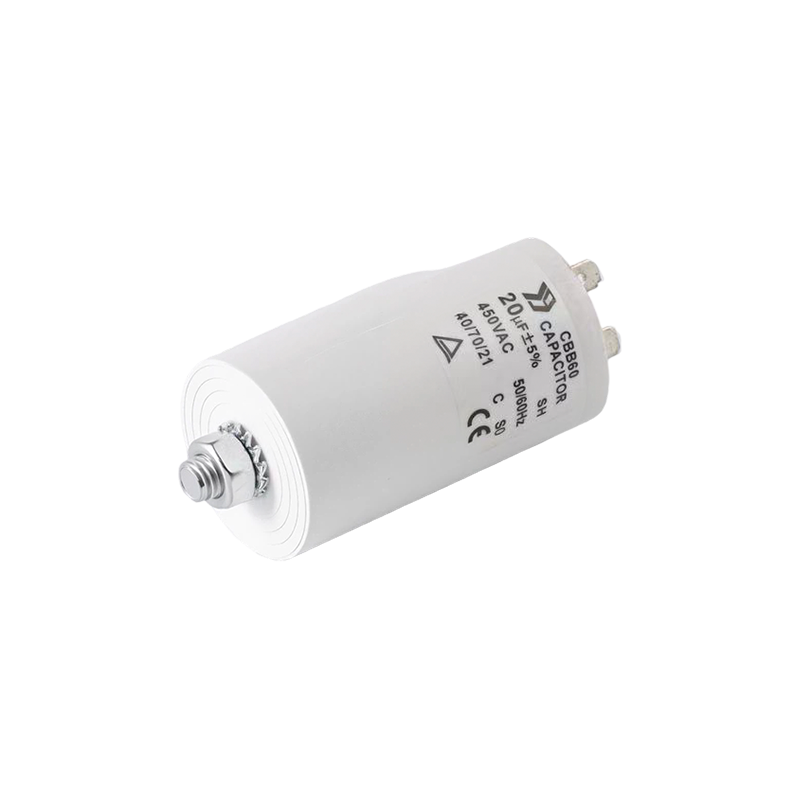
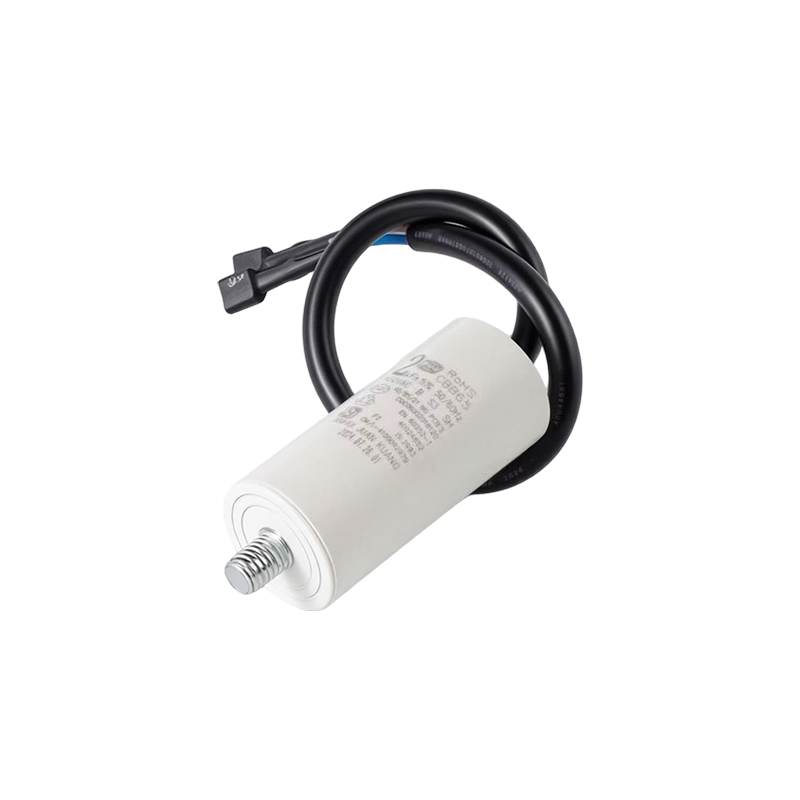
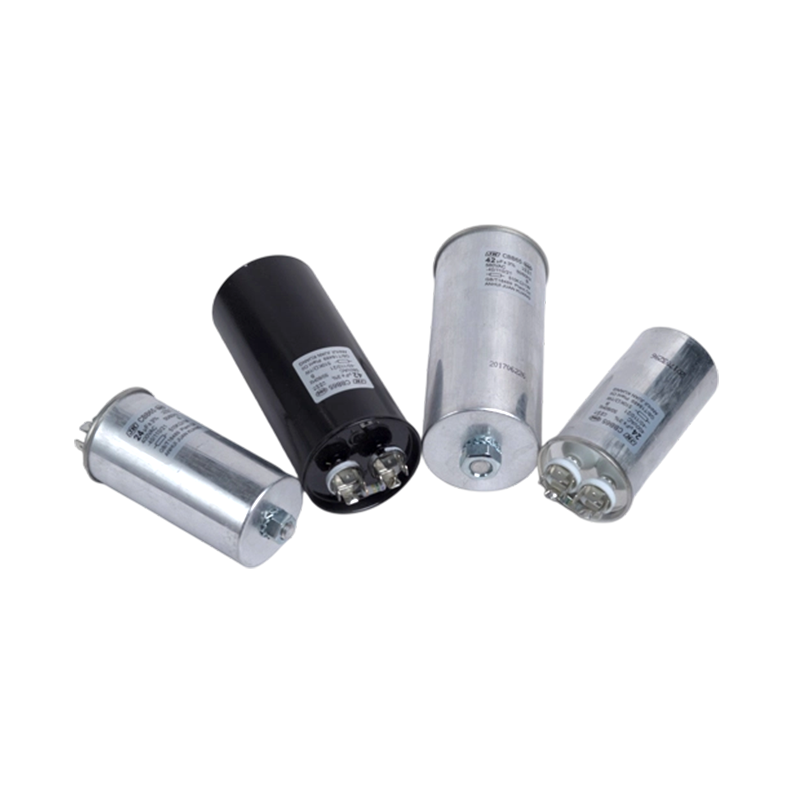
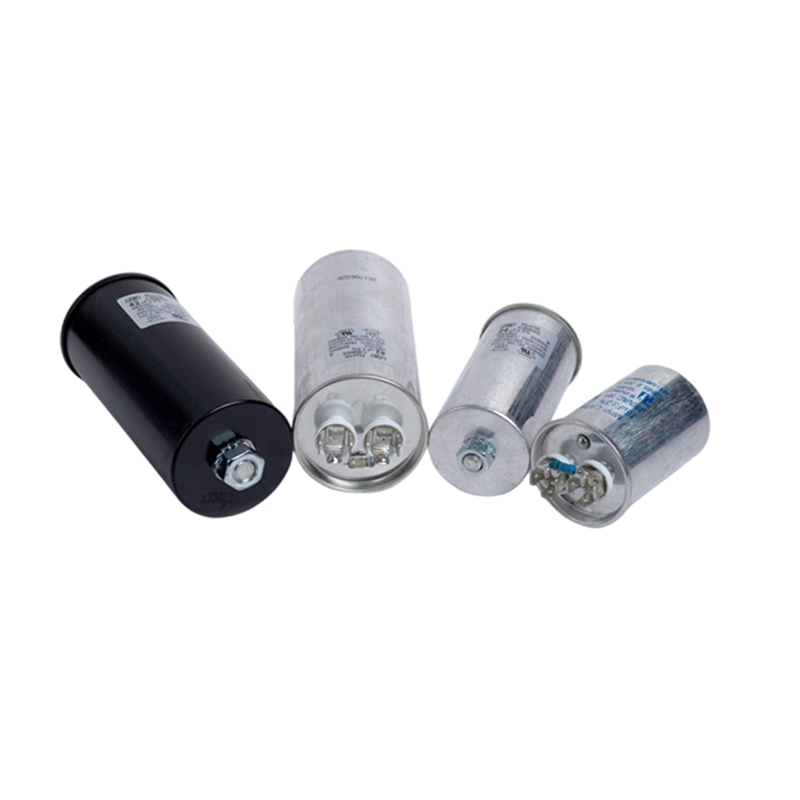
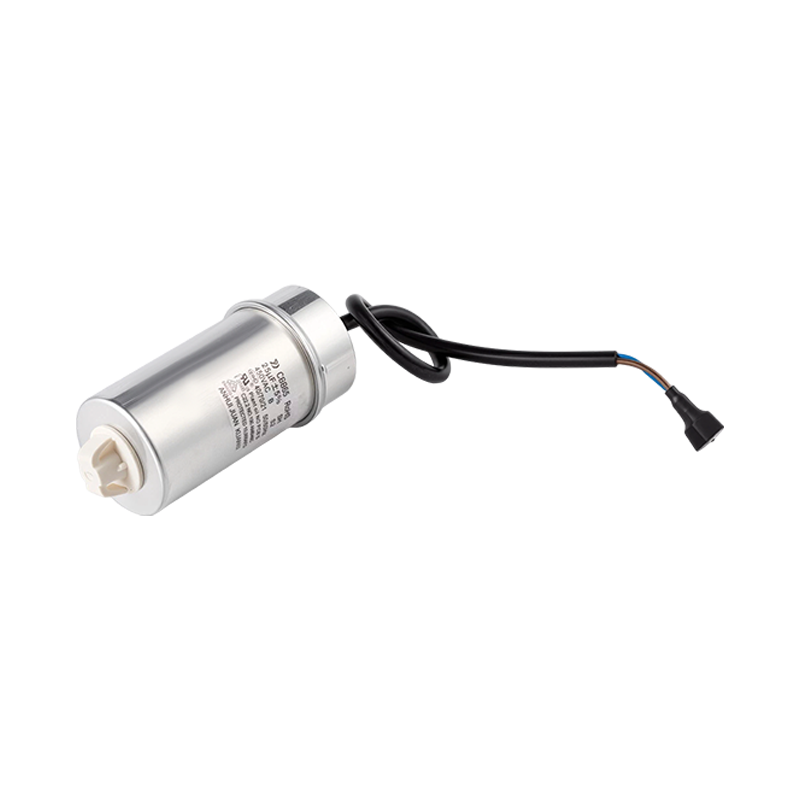
CBB60 and CBB65 are both cylindrical metallized polypropylene motor capacitors with the same electrical function; the CBB60 uses a plastic case and the CBB65 an aluminium case, so the choice comes down to heat path, mounting space and the mechanical protection the appliance design expects.
| Property | CBB60 | CBB65 |
| Case | Cylindrical plastic, often flame retardant | Cylindrical aluminium can |
| Typical capacitance | 4 to 20 uF | 10 to 60 uF |
| Terminals | Two spade tags, some three-wire versions with a common tag | Two or three tags on the lid, sometimes with an earthing tag on the can |
| Heat path | Plastic insulates, so heat leaves through the element ends | Aluminium spreads heat across the surface and lowers the hot spot |
| Common laundry use | Drum motors and drain pumps in compact and top-load machines | High-torque drum motors and washer-dryer combinations |
| Mounting | Strap or bracket around the body | Clamp around the can, case can be bonded to earth |
Inside both, the construction is the same: metallized polypropylene film wound into a flat element, end-sprayed and sealed into the case. What changes is how heat escapes and how the part is fixed. A plastic case is cheaper and insulating but traps heat; an aluminium can spreads heat to the surface and to the mounting clamp, which is worth several degrees of hot-spot temperature in a tight compartment.
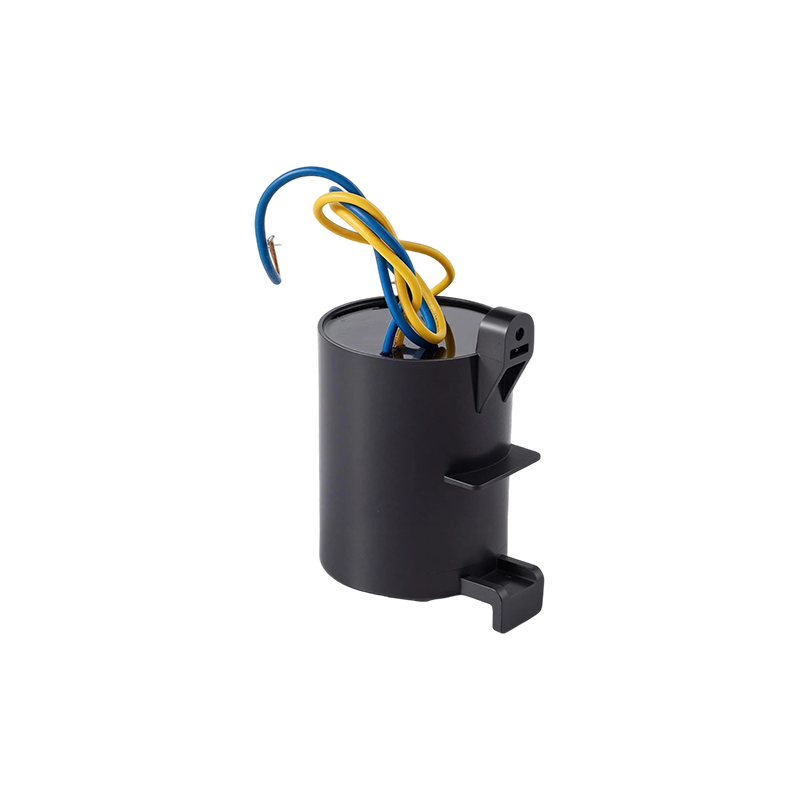 CBB60 Plastic-Case Washing Machine Motor CapacitorCylinder plastic-case metallized film AC motor capacitor for washing machines, with S0 protection and customizable ratings and dimensions; compare its heat and mounting trade-offs.View Product →
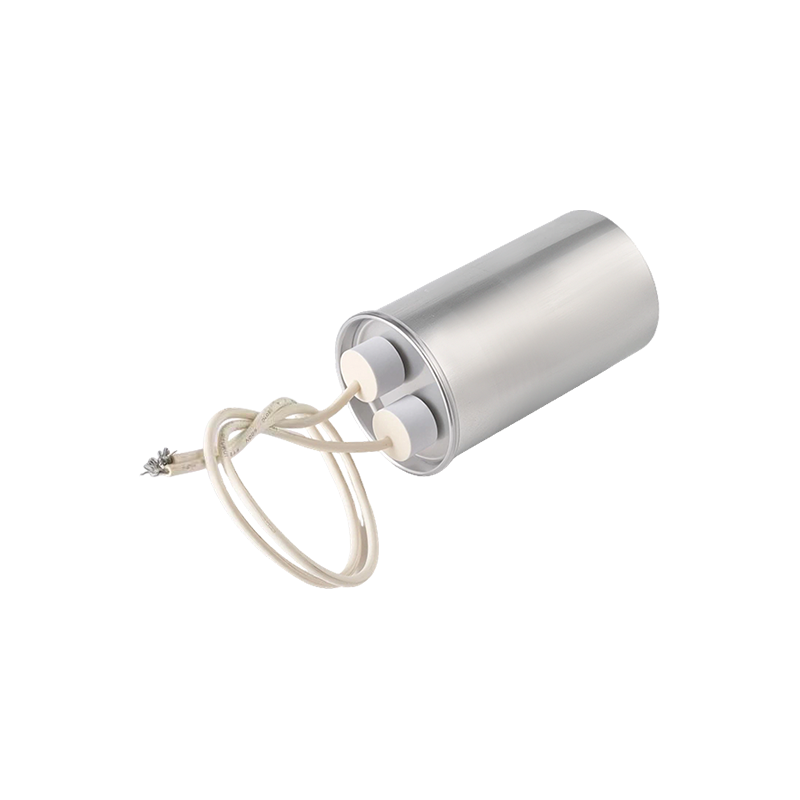 CBB65 Aluminum-Case Washing Machine Motor CapacitorFully sealed aluminum-case AC motor capacitor with S2 explosion-proof protection, offering start and run support with customizable ratings; relevant when heat spreading and clamp mounting matter.View Product →
Reading the Nameplate: Capacitance, Voltage, Tolerance and Temperature
Four markings decide whether a capacitor survives a laundry appliance: rated capacitance in microfarads, rated AC voltage, capacitance tolerance and upper category temperature.
- Capacitance and tolerance. The motor was designed around one value. A 12 uF +/-5 % part should measure between 11.4 and 12.6 uF when new.
- Rated voltage. 400, 450 and 500 VAC are all common. A higher rating is not automatically better if it arrives in a case that will not fit the bracket.
- Temperature class. Minus 25 to plus 70 deg C covers most laundry designs; a capacitor bolted beside the motor may need the 85 deg C version.
- Safety class. S0, S1 and S2 to IEC 60252-1 describe what the device does at end of life. S2 devices are expected to break the circuit rather than short.
- Life class. Class A is rated near 30,000 hours, class B near 10,000 hours and class C near 3,000 hours at rated voltage and temperature.
Why Washing Machine Capacitors Fail in Wet, Hot Environments
Most laundry capacitor failures are capacitance loss rather than a dead short: moisture, sustained heat and repeated self-healing gradually remove active electrode area until the motor no longer receives enough phase shift.
What the technician sees
- Drum hums but does not turn
- Spin cycle weak or inconsistent
- Motor trips its thermal protector
- Case bulged, terminals corroded
- Capacitance 15 to 30 percent low
What happens inside
- Self-healing clears film defects and isolates the spot
- Humidity raises leakage current and corrodes the metallized edge
- Heat shrinks the film and loosens the end connection
- Each healing event removes a little more electrode
- Effective capacitance falls and phase shift weakens
The self-healing property that makes metallized film reliable is also the mechanism behind slow capacitance loss, which is why the part degrades quietly instead of dying overnight.
Film choice matters here as well. The metallization can be plain aluminium or aluminium-zinc, and the two behave differently under humidity and repeated self-healing, so the film specification belongs in the purchasing document next to the capacitance.
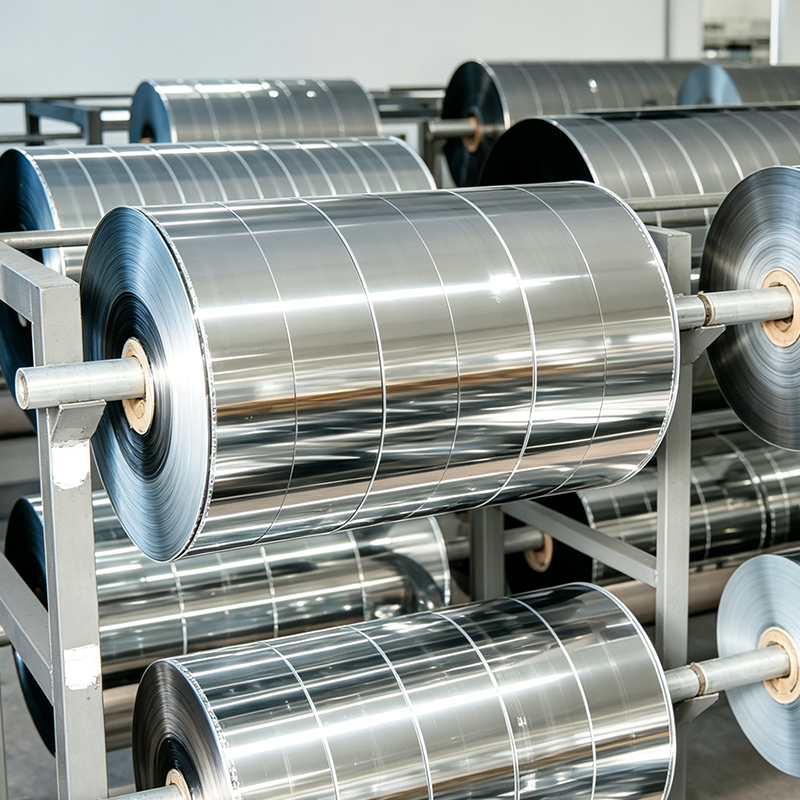 Aluminum-Metallized Polypropylene Films for CapacitorsMPPA and MPPAZ metallized polypropylene films in multiple thicknesses and slit widths, relevant where film metallization choice affects humidity and self-healing behavior.View Product →
Testing and Deciding Between Replacement and Rework
Measure the capacitor out of circuit with a meter that reads microfarads, compare the result against the nameplate and its tolerance band, and replace anything that falls outside it.
- Isolate and discharge. Unplug the appliance, disconnect at least one terminal and discharge the part through a resistor before touching the tags. A capacitor can hold a charge after the machine is switched off.
- Measure capacitance. A 12 uF +/-5 % part should read 11.4 to 12.6 uF. A reading 15 percent low means electrode area is already gone, even if the drum still turns on a light load.
- Inspect the part. A swollen case, oil residue, green corrosion on the spade tags or a loose crimp are grounds for replacement regardless of the meter reading.
- Match the replacement. Same capacitance, equal or higher voltage, equal or higher temperature class, and the same terminal layout and mounting. Case style follows the bracket, not personal preference.
Sourcing Checklist for Appliance and Motor Manufacturers
For an appliance manufacturer the capacitor is a safety-relevant purchased part, so the specification should pin down capacitance tolerance, voltage rating, temperature class, safety class and expected life in one document.
- Capacitance window and measuring conditions. A 1 kHz reading and a 50 Hz reading of the same part can differ, so name the frequency and the temperature in the drawing.
- Voltage and temperature headroom measured in the real compartment, not on a laboratory bench.
- Safety class and fail mode, tied to the appliance standard that applies to the end product.
- Terminal and lead configuration, including plating that will survive condensation and detergent residue.
- Life class and batch consistency, with a stated capacitance distribution across production lots.
Ask for capacitance distribution data, not only a datasheet. A supplier that can show 100 % capacitance and hipot testing per batch is far easier to qualify than one that quotes a tolerance band and nothing else.
Our company has manufactured film capacitors since 1995 and took part in drafting GB/T 3667.1, the AC motor capacitor standard aligned with IEC 60252-1. A short company background covers the history and the current product scope.
Frequently Asked Questions
How do I know if the washing machine capacitor is faulty?
The usual signs are a drum that hums without turning, a weak or inconsistent spin, and a motor that trips its thermal protector. Confirm it by measuring capacitance out of circuit: a 12 uF part reading below roughly 11 uF has lost the phase shift the motor was designed around.
Can a 10 uF capacitor replace a 12 uF one?
Not safely. Lower capacitance reduces the phase shift and the starting torque, and the motor draws more current to compensate, which raises winding temperature. Stay inside the original tolerance band and keep the voltage rating equal or higher.
Why do washing machine capacitors fail after a few years?
Continuous AC duty, motor heat and humidity all attack the film. Every self-healing event removes a small area of electrode, so capacitance falls slowly and the machine keeps working until one morning it cannot start a loaded drum.
Do CBB60 and CBB65 capacitors use the same wiring?
Most are two-terminal devices, but three-terminal versions with a common tag exist in both families, and the aluminium CBB65 sometimes carries an earthing tag on the can. Match the terminal layout and the mounting first, then the brand.